


Best bin liners for commercial kitchens in 2026
, by Editorial Team, 15 min reading time
, by Editorial Team, 15 min reading time
Best overall: WY-03 120L for kitchens using matching 120L bins. Best for smaller general-waste bins: WY-02 80L. Best for standard 240L wheelie bins: WY-01 240L. Lower ongoing costs start with buying bin liners for commercial kitchens that fit your bins and suit the waste—not putting the largest bag everywhere. Valuepackperth supplies wholesale food packaging to Perth food businesses; this 2026 guide compares the supplied liner specifications and gives you a practical buying checklist.
A liner that slips into the bin or tears during removal creates another job during service. An oversized liner also leaves you paying for material your smaller bin does not need. The best buying decision is the smallest suitable liner that stays secure and handles your actual waste.
For Perth cafés, restaurants and takeaway operators buying in 2026, separate the questions of size and strength. A bag can have enough capacity but still lack the opening width or spare length needed to fold over the rim.
Valuepackperth's bin liners for commercial kitchens are best for Perth operators seeking recycled-plastic liners matched to 80L, 120L or standard 240L bins. The choice between them starts with your bin, not a blanket recommendation to use the thickest bag.
Use these criteria before you compare cartons:
A recycled-plastic liner is not automatically a compostable liner. Keep that distinction clear when choosing bags for general waste versus a food-organics collection.
The 2026 ranking below compares the supplied specifications. It is a selection guide, not a claim that every kitchen should use the first option.
| Rank and liner | Best for | Standout specification | Dimensions | Carton quantity | Key limitation |
|---|---|---|---|---|---|
| 1. WY-03 120L | Matching 120L kitchen bins | Recycled plastic, 30 microns | 810 × 950mm | 240 liners | Not a universal fit for smaller bins or wheelie bins |
| 2. WY-02 80L | Smaller general-waste bins | Recycled plastic, 25 microns | 760 × 900mm | 240 liners | Thinner film than the other listed options |
| 3. WY-01 240L | Standard 240L wheelie bins | Recycled plastic, 50 microns | 1150 × 1500mm | 100 liners | Larger format is unnecessary for smaller indoor bins |
All three listed liners are black and made from recycled plastic. Their different sizes serve different jobs; none should be selected solely because it appears higher in the table.
WY-03 120L is a black recycled-plastic liner measuring 810 × 950mm, with a stated thickness of 30 microns. The supplied description positions it as an all-purpose bag, and each carton contains 240 liners.
WY-03 120L is the default choice when your kitchen already uses matching 120L bins. It occupies the middle size and thickness position in this comparison. That makes it the first specification to check for that bin size—not proof that it will handle every waste load.
Best for: Kitchens with 120L bins that need an all-purpose general-waste liner.
Before making WY-03 120L your standard order, fit a liner, fold it over the rim and check that it reaches the base without tension. Then assess removal with representative waste rather than testing only an empty bag.
Verdict: Buy WY-03 120L for matching 120L bins after checking fit and waste handling.
WY-02 80L is a black recycled-plastic liner measuring 760 × 900mm at 25 microns. Its supplied description identifies it as an everyday general-waste option, and each carton contains 240 liners.
Choose WY-02 80L when your smaller bin fits this liner properly. Do not choose it as a substitute for a larger liner merely because the carton contains the same number of bags.
Best for: Smaller café or kitchen general-waste bins that match the liner dimensions.
For your 2026 ordering list, give each smaller bin a named liner specification. That avoids staff using whichever carton is closest and discovering halfway through service that the bag will not fold over the rim.
Verdict: Buy WY-02 80L for matching smaller bins; skip it as a replacement for a larger required size.
WY-01 240L is a heavy-duty black recycled-plastic liner measuring 1150 × 1500mm at 50 microns. Its supplied description states that it is designed to fit standard 240L wheelie bins. Each carton contains 100 liners.
WY-01 240L is the wheelie-bin choice in this comparison. The larger dimensions and thicker stated film distinguish it from the indoor-bin options, but neither specification makes overfilling safe.
Best for: Standard 240L wheelie bins requiring a liner.
Keep the distinction between lining a wheelie bin and lifting a full bag out of it. Assess the waste-handling method separately, and do not assume a large liner can safely be carried once filled with dense kitchen waste.
Verdict: Buy WY-01 240L for standard 240L wheelie bins; skip it for smaller indoor bins.
Use this sequence for every bin location, from the coffee station to the main kitchen. Record the result once, then make the approved liner easy for staff to identify.
The litre rating helps narrow your selection. The fit trial decides whether the liner works in your bin. Check access as well: a bag that fits can still be awkward to remove from a cabinet-mounted bin.
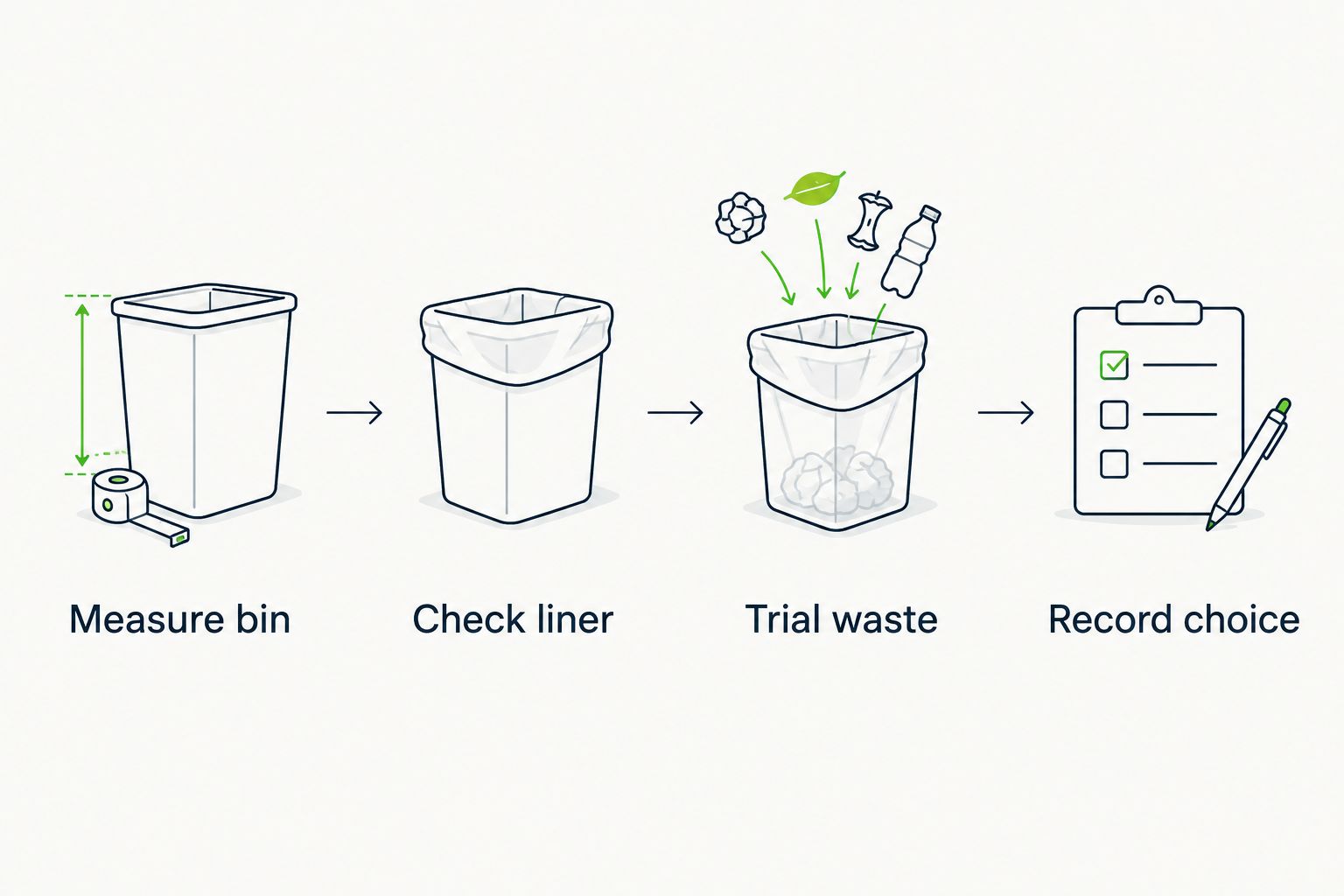
For enquiries to Valuepackperth, provide your bin capacity, measurements, waste type and expected carton usage. That gives the buying discussion a specific starting point instead of an open-ended request for the strongest bag.
Use the specifications above to narrow your selection, then confirm current product details before ordering.


Start with a bin-location list rather than one liner size for the whole business. Your preparation area, coffee station and wheelie bins do not automatically need the same bag.
Use that record when reviewing wholesale orders in 2026. Buying more cartons does not fix a liner that continually slips, and changing liner thickness does not fix an overfilled bin.
When comparing quotes, use the same size, dimensions, thickness and carton quantity. A 100-liner carton and a 240-liner carton are different ordering units, even before you assess whether the liners serve the same job.
The ranking prioritises a clear bin-size use case, published dimensions, stated film thickness and carton quantity. WY-03 120L takes the default slot for matching kitchen bins; WY-02 80L serves smaller general-waste bins; WY-01 240L serves standard wheelie bins.
This is a specification-based comparison. It does not rank tested tear strength, seam performance or lifting capacity, and it does not treat recycled content as evidence of compostability.
Choose WY-03 120L if your main kitchen bins match its 120L format and 810 × 950mm dimensions. Choose WY-02 80L for matching smaller bins and WY-01 240L for standard 240L wheelie bins.
For your next Valuepackperth enquiry, send a short list of bin locations and required specifications. Ask for the matching wholesale options rather than requesting one universal bag for the entire venue.
The practical 2026 decision is fit first, handling second, carton planning third. Keep the chosen liner only if it works through normal service and removal.
What's the best bin liner for a commercial kitchen?
WY-03 120L is the default in this comparison for kitchens with matching 120L bins. Check its 810 × 950mm dimensions against your bin and assess it with representative waste before standardising your order.
Is a 50-micron bin liner better than a 25-micron liner?
A 50-micron liner has thicker film, but thickness alone does not establish suitability. WY-01 240L and WY-02 80L also differ in capacity and dimensions, so choose by bin fit and waste handling rather than microns alone.
What size liner should I use for a standard 240L wheelie bin?
WY-01 240L is explicitly described as designed for standard 240L wheelie bins. Its stated dimensions are 1150 × 1500mm, and its recycled-plastic film is 50 microns thick.
Are recycled-plastic bin liners compostable?
Recycled-plastic construction does not establish compostability. Confirm the accepted liner material with your food-organics collector before using any bag in that stream.
How many bin liners are in each carton?
WY-03 120L and WY-02 80L each contain 240 liners per carton; WY-01 240L contains 100. Compare carton quantities alongside size and thickness when planning orders.
Can I use one bin liner size throughout my café?
Use one size only where it fits every relevant bin and suits the waste-handling task. Separate smaller indoor bins from standard wheelie bins when choosing your liner specifications.
What should I include in a wholesale bin liner enquiry?
Include bin capacity, opening measurements, depth, waste type and expected usage. These details make it easier to compare suitable liner specifications and carton quantities.
Check the rim before blaming the bag. A liner pulled tight across the opening has less spare material to fold over and secure, even when its nominal capacity sounds right.
Keep a record of the liner that actually fits each bin. A simple bin-location label makes that buying decision usable by every staff member, not just the person who places the order.